You can review information about the results of running a Data Workflow in the Workflows List Last Run Status column and Run History panel. Each run has a status. For a log of each processed record, use the Performance Details page.
Last Run Status column
Every published workflow in the Workflows List has a Last Run Status column with icons so you can easily find out what is going on when they run.
Run History panel with details
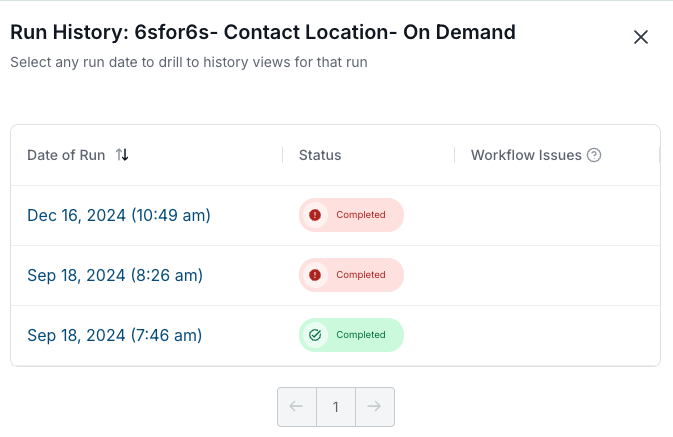
To get details about a run’s status, use the Run History panel. It shows a list view of each run of the workflow. For example, a workflow scheduled to run daily has a run history that lists each day’s run from the start date until the present or end date.
To access a workflow’s run history:
Go to Data Workflows > Workflows List. If a workflow has run, a View button appears in its Run History column. Use Search or filter by Published to narrow down the results.
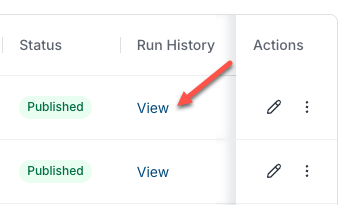
In the Run History column for a workflow, select View.
The Run History panel opens and lists the runs by date, shows the run status, and explains issues, if any.
Run status icons and meanings
Hover over a status icon for a brief explanation. Statuses include:
Blank: Workflow has not yet run.
In Progress: Workflow is still running.
.png)
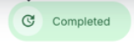
Completed: Workflow completed successfully.
.png)
Completed with at least one error: Workflow processed successfully, and there is a problem with records (such as when updating an external application). Hover over the icon and/or click the run date to for more information. Refer to Troubleshoot Audience Workflows.
.png)
Completed with timer (on-demand workflows only): Workflow processed successfully, and there is a timer node. Refer to Workflows Time Node.
Completed with timer and error (on-demand workflows only): There is at least one error and a timer node is still running. Refer to Workflows Time Node.
.png)
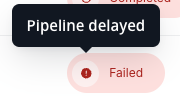
Failed – The workflow process failed. This may be due to a delay in the nightly pipeline. Hover over the icon for a message. Refer to Troubleshoot Audience Workflows.
Tip: A workflow may have a non-blank last run status even if its status is unpublished. This would indicate that the workflow was published and ran for a time and was later unpublished.
Performance Details (audit log) page
The Data Workflows Performance Details page is a log of all records processed by that workflow over a specific date range.
To access performance logs:
From the Data Workflows main menu, select Data Workflows.
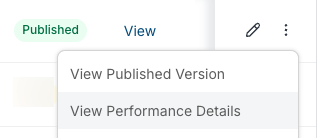
At the right of the listed workflow, select More (the vertical dots) > View Performance Details.
The page opens, showing the workflow name, segment used, frequency, creator, and a date range.
The performance details page has the following tabs, depending on the nodes used in the workflow:
Records: Activity related to records.
The records tab has different table views you can select at the left column:
Contacts Purchased: includes purchased contacts and accounts, those rejected, errors, and those that you can re-push. Refer to Re-push failed purchase contacts or leads.
CRM Accounts: includes enriched, updated, merged, assigned, created, and skipped accounts.
CRM Contacts: includes enriched, merged, updated, assigned, and skipped contacts.
CRM Leads: includes enriched, converted, merged, updated, assigned, and skipped leads.
MAP Leads: includes enriched, updated, and skipped leads.
Errors: Shows a list of errors. Each error has a description and suggested action.
Re-Push failed purchased contacts or leads
In some instances, Data Workflows is unable to push purchased contacts or leads to your destination system. When this occurs, we recommend that you “Re-Push” the record.
To re-push a failed purchase:
Go to the Data Workflows Workflows List.
For the workflow, select More (the vertical dots) > View Performance Details.
Select the Errors tab.
Select Re-push All.
Select Continue.
After you select Re-push All, the process starts and is indicated by a popup.